“ADHD Or CPTSD?” Is The Wrong Question. Here’s Why You’re Stuck.
Executive dysfunction or freeze response. Time blindness or dissociation. That’s the trap.

You’re staring at two diagnoses trying to figure out which one is real. That question is the trap.
Executive dysfunction or freeze response? Hypervigilance or autistic processing?
Time blindness or dissociation?
Rejection sensitivity or fawn response?
You got the ADHD diagnosis. It explained so much. The relief lasted three weeks, until you started unpacking the abusive relationship, the bullying workplace, the family system that taught you to scan for danger before you could speak. Now you’re sitting with two sets of symptoms that look identical, and every professional you’ve seen has a different answer.
Your GP says it’s trauma. Your psychiatrist says it’s ADHD. Your therapist says “maybe both?” but offers no framework for what that actually means.
So you’re left googling at 2am: “ADHD or CPTSD quiz”.
“Can trauma cause ADHD symptoms”. “How to tell the difference between ADHD and CPTSD”. Trying to draw clean lines between diagnoses. Trying to figure out which parts of you are “real neurodivergence” and which parts are “just damage from what happened.”
Nobody’s telling you the question itself is keeping you stuck.
I see this every week in my practice. Brilliant women finally getting the ADHD diagnosis that explains decades of feeling wrong, and the relief curdles the moment they start unpacking what came before. The relationships that destroyed them. The workplaces that targeted them. The patterns that started so early they can’t remember a time before.
They ask their GP. “Probably trauma, focus on healing first.” They ask their psychiatrist. “The ADHD diagnosis is solid, trauma work can wait.” They ask their therapist. “Maybe both?” And nobody can tell them which one is real.
So they become obsessed with figuring it out. Because how can you fix the right thing if you don’t know what the actual problem is?
At some point, the question itself becomes the problem.
The same symptom. Two diagnoses. Nobody can tell you which one is real.
Can’t start tasks. Is ADHD executive dysfunction from dopamine dysregulation? Or CPTSD freeze response from years of walking on eggshells?
Time disappears. Hours vanish. Look up from work and it’s dark outside with no idea where the day went. ADHD time blindness or dissociation?
Always scanning. Reading rooms, monitoring everyone’s emotional temperature, knowing when someone’s mood shifts before they’ve said a word.
ADHD sensory sensitivity or hypervigilance learned in relationships where survival depended on predicting the next move?
Emotions are volcanic. Fine to enraged in seconds. Crying over something small. Complete shutdown.
ADHD emotional dysregulation or a nervous system stuck in threat mode?
Can’t remember conversations. Lose track mid-sentence. Someone references something you apparently said and there’s no memory of it. ADHD working memory deficits or trauma-related memory fragmentation?
Every symptom. Two explanations. And nobody can definitively say which one is true.
Your GP says trauma. Your psychiatrist says ADHD. Your therapist says “maybe both?” and nobody has answers.
The GP wants to treat the trauma first. ADHD symptoms often improve once you’ve processed trauma, they say. Focus on therapy before medication. As if healing properly might make the ADHD disappear.
The psychiatrist disagrees. The ADHD diagnosis is clear. Medication will help regardless of trauma history. The trauma is almost irrelevant, something therapy can handle separately.
The therapist tries to hold both. Trauma and ADHD often overlap. It’s possible to have both. They can work on trauma processing while exploring medication. But ask directly, “Which one is causing my executive dysfunction?” and there’s no answer. It’s complicated.
These things are intertwined. Maybe the question itself isn’t helpful.
You leave furious. Not at the therapist. At the situation. How are you supposed to get better if nobody can tell you what’s actually wrong?
The research made it worse
So you read everything. ADHD and CPTSD and the overlap between them. The more you read, the more confused you become.
Some sources say trauma can’t cause ADHD because ADHD is neurodevelopmental. You’re born with it. It’s genetic. So if you have trauma responses that look like ADHD, you don’t really have ADHD. You just have unprocessed trauma mimicking the symptoms.
Other sources say ADHD makes you more vulnerable to trauma. The impulsivity, emotional intensity, difficulty reading social cues put you at higher risk for abusive relationships and bullying. So the trauma is real but it was caused by the ADHD. Treat the ADHD first.
Still other sources say CPTSD is increasingly recognised as acquired neurodivergence. Trauma rewires your brain, changes neural pathways, affects executive function. So maybe it’s not ADHD at all.
Maybe it’s just a traumatised brain working differently.
Spreadsheets get made. Symptoms get colour-coded. Timelines get traced. But memory is so fragmented you can’t trust your own evidence. And the harder you try to separate ADHD from trauma, the more tangled everything becomes.
Which came first? The question that paralysed her for months
If she could just figure out whether she had ADHD before the trauma, that would prove the ADHD is real and the trauma just made it worse. But she can’t remember. Diagnosed at thirty-seven. The relationship ended at thirty-four. But before there was a different relationship, also bad. Before a workplace that systematically targeted her. Before a family system that taught her to scan for danger before she could speak.
How far back does she need to go to find the “real” version? The one untouched by trauma, exhibiting pure ADHD symptoms that can be clearly identified and treated?
The version doesn’t exist. Every version she can remember was already adapting, already in survival mode, already trying to be smaller or quieter or more acceptable.
So she tries a different question. “If I heal the trauma, will the ADHD go away?”
Because if yes, it was never really ADHD. If no, the ADHD is real and she should focus on it. But nobody can answer. You can’t run the experiment. You can’t heal trauma then check if ADHD symptoms disappear, because healing takes years and ADHD presents differently across your lifespan anyway.
She’s stuck. Completely stuck.
And the question she’s asking has become the thing keeping her paralysed.
The reframe that broke the cycle
A client came to me deep in this loop. Spreadsheets. Symptom tracking. Desperate need for someone to finally tell her which diagnosis was correct.
I listened.
Then I asked something she wasn’t expecting.
“What if both are real and trying to separate them is keeping you stuck?”
She started to argue. She needed to know which was which so she could treat the right thing in the right order. You can’t build a treatment plan without knowing what you’re treating. Diagnostic clarity was essential.
I waited. Then asked, “What support would you need if we stopped trying to figure out which diagnosis gets credit?”
She didn’t have an answer. Months focused on diagnostic certainty and she’d never asked what she actually needed.
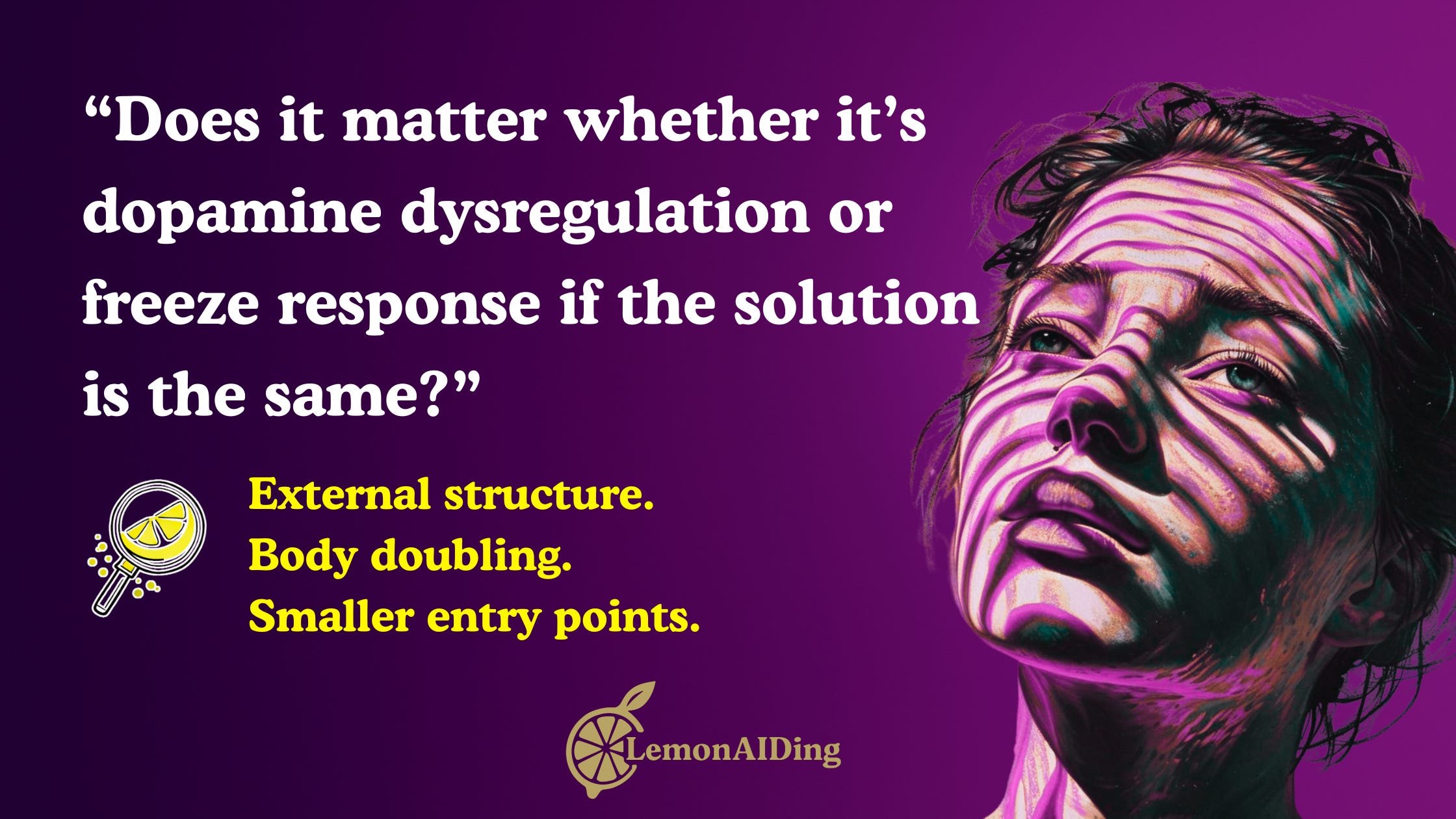
“Your executive dysfunction makes starting tasks nearly impossible. Does it matter whether dopamine dysregulation or freeze response if the solution is the same? External structure, body doubling, breaking tasks smaller?”
“Your hypervigilance exhausts you. Does it matter whether sensory sensitivity or learned threat detection if either way you need nervous system regulation and safer environments?”
“Your time blindness means deadlines ambush you. Does it matter which diagnosis explains it if you need external time markers and buffer periods regardless?”
I wasn’t dismissing the question. I was reframing it. She wasn’t wrong to want clarity. She was waiting for diagnostic certainty before giving herself permission to build support.
We designed systems in that first session. Not generic productivity tools. Leadership infrastructure built for her actual brain. External structure for task initiation. Energy management for fluctuating capacity. Environmental design so hypervigilance could redirect toward strategic pattern recognition instead of threat scanning.
Two weeks later, she messaged.
“Board meeting yesterday. I walked in prepared. No last-minute panic. No scanning the room for threats. Just showed up and led. The system we built held.”
Your brain doesn’t organise itself by diagnostic category
ADHD isn’t static. It doesn’t exist sealed off from your experiences. Growing up neurodivergent in unsafe conditions doesn’t give you ADHD and trauma as two separate things. It creates a feedback loop.
And for many women getting late ADHD diagnoses, there’s another layer.
Autism. The intersection creates its own complexity.
The ADHD traits - emotional intensity, rejection sensitivity, impulsivity - make you more vulnerable to targeting. The autistic traits - honesty, rule-following, difficulty reading social manipulation - make you easier to exploit. The targeting creates trauma. The trauma rewires how both the ADHD and autism present.
CPTSD doesn’t just wound you psychologically.
It changes your brain. Neural pathways shift. Threat detection recalibrates. Executive function reroutes through your amygdala instead of your prefrontal cortex. Trauma changes the architecture of how your brain processes information.
So when you’re experiencing executive dysfunction, you’re not experiencing “ADHD symptom” versus “autism symptom” versus “trauma symptom” in some diagnostic competition. You’re experiencing a brain wired for dopamine dysregulation and pattern-based processing, spending years in survival mode, and now it can’t distinguish between “lacks stimulation” and “feels threatening.”
The symptoms aren’t separate. The brain adapted to all of it simultaneously. Trying to pull them apart doesn’t give you clarity. It keeps you in analysis instead of support.
What happened when she stopped waiting for certainty
She stopped waiting for diagnostic certainty before building support. She worked with what was actually true. She had executive dysfunction, regardless of cause. She had emotional intensity that could be redirected. She had hypervigilance exhausting her but also giving her pattern recognition nobody else had. She had a nervous system needing regulation and a brain needing external structure.
We built leadership infrastructure around how her brain actually works. Not therapy to process trauma first.
Not waiting until ADHD medication “fixed” executive function.
Executive function coaching that designs systems for the brain she has right now. External structure for task initiation because waiting for internal motivation was pointless. Energy management honouring fluctuating capacity instead of demanding consistency. Environmental design so her hypervigilance could redirect toward pattern recognition instead of threat scanning. Meeting preparation frameworks that worked with her processing style instead of requiring her to think like neurotypicals.
The work wasn’t healing ADHD or processing trauma separately. The work was designing leadership capacity around the integrated reality of how her brain operates.
The brain you have right now deserves support. Not diagnostic proof
If you’re stuck where she was, trying to figure out which diagnosis is “real”, you’re not confused. You’re not failing to see clearly. The symptoms genuinely overlap this completely. The professionals genuinely disagree this much. And the question you’re asking genuinely cannot be answered.
It’s not that you’re not trying hard enough. But the question itself assumes a separation that doesn’t exist.
You can have ADHD and trauma. You can have ADHD making you more vulnerable to trauma. You can have trauma rewiring your brain to present like ADHD. You can have autism layered with ADHD and trauma creating patterns that can’t be attributed to just one. All of those are real. All of those exist. And none need to be definitively proven before you’re allowed support.
You don’t need to know which came first. You don’t need to wait until you’ve healed trauma to address ADHD, or vice versa. You don’t need diagnostic certainty to start building what makes your life workable.
The brain you have right now, the one experiencing executive dysfunction and emotional intensity and time blindness and hypervigilance all at once, the one brilliant and adaptive and trauma-impacted and neurodivergent simultaneously, is real.
All of it. And it deserves support, not diagnostic proof.
Next week: The room is on fire. You’re finally calm. Here’s why that’s not actually broken.
This is LemonAIDing.
Not separating ADHD from trauma from autism.
Not waiting for diagnostic certainty before you’re allowed support.
Designing leadership infrastructure around the brain you actually have.
#HelloMyNameIs Rachael
I work with leaders who refuse to untangle themselves before they’re allowed to function.
LemonAIDing™ is executive function coaching for the whole picture, not isolated diagnoses.
Read the full series: